The Homo divergens Project
Top Ten Most Influential U.S. Presidents
A politically neutral, historically grounded list of the ten most influential U.S. presidents. The selection and attribution of H. sapiens vs. H. divergens leaning is based on the Micro16 and Macro 16 frameworks, and on their long-term impact on national institutions, constitutional development, geopolitical structure, economic order, and political realignment of the United States.
| George Washington | Abraham Lincoln | Thomas Jefferson | Theodore Roosevelt | Woodrow Wilson | Franklin Roosevelt | Harry Truman | Dwight Eisenhower | Lyndon Johnson | Ronald Reagan |
Biography
Micro16 Markers
Biography
Micro16 Markers
Biography
Micro16 Markers
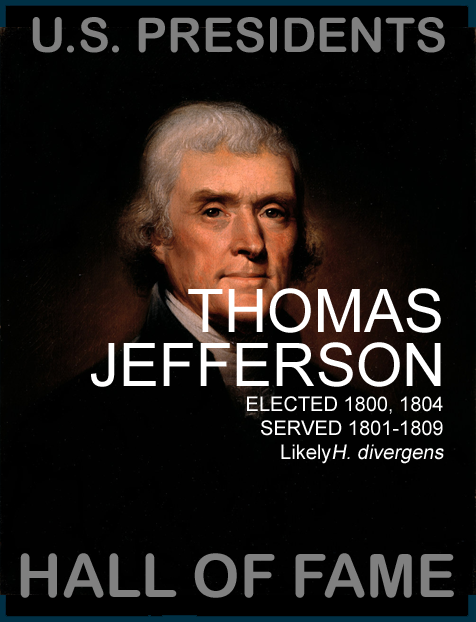
Jefferson
Card in preparation
Biography
Micro16 Markers
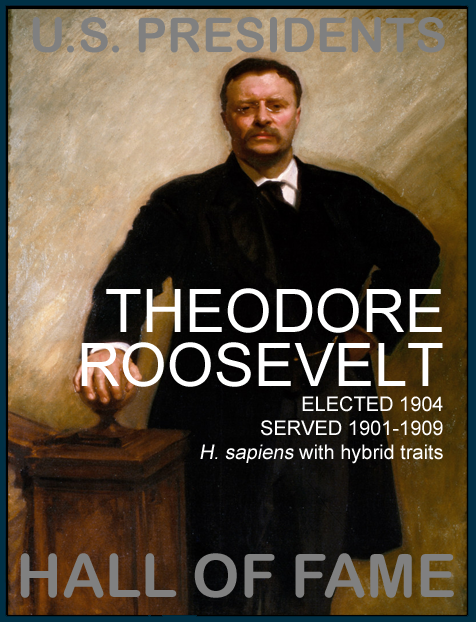
T. Roosevelt
Card in preparation
Biography
Micro16 Markers
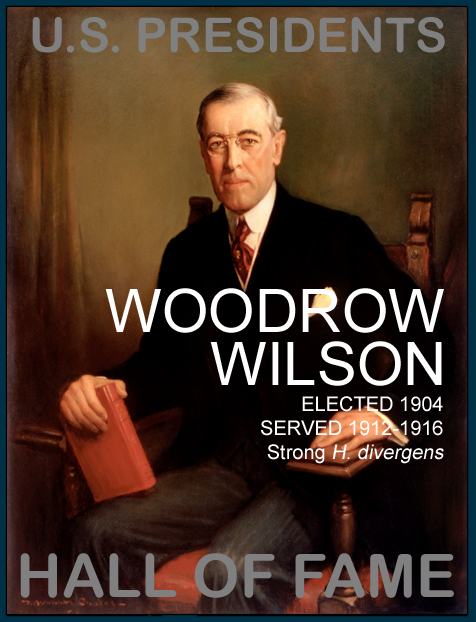
Wilson
Card in preparation
Biography
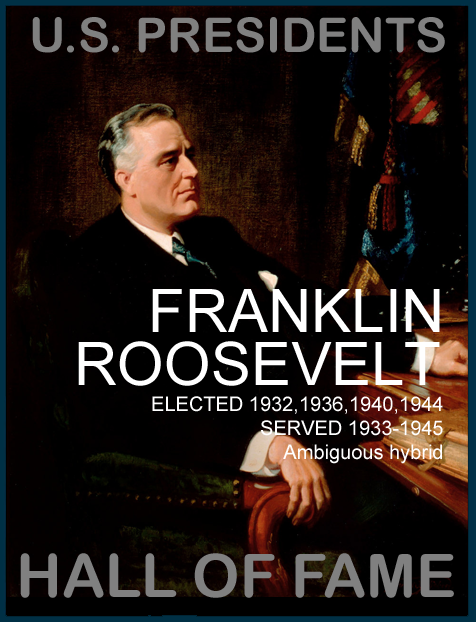
Franklin Delano Roosevelt, the 32nd President of the United States, served an unprecedented four terms from 1933 until his death in 1945, guiding the nation through the twin crises of the Great Depression and World War II. Born into a patrician New York family, Franklin D. Roosevelt was shaped by the Northeastern elite’s culture and values, attending Harvard and briefly studying law at Columbia. His early career included roles as a state senator, Assistant Secretary of the Navy, and Governor of New York, experiences that honed his pragmatic, adaptive approach to leadership.
Though he had no personal military service, Franklin D. Roosevelt’s tenure at the Navy Department during World War I provided him with critical administrative experience. As a mainline Protestant (Episcopalian), he emphasized civic morality and collective responsibility, values that would underpin his presidency. Renowned for his optimism, confidence, and emotional buoyancy, Franklin D. Roosevelt was a strategic and adaptive leader, especially under pressure. His crisis response style was marked by systemic, improvisational, and experimental policy iteration, a hallmark of his approach to the unprecedented challenges he faced.
A master communicator, Franklin D. Roosevelt used his “fireside chats” to reassure the public, blending empathy with clear policy explanations. His leadership was characterized by systems-level thinking, high emotional attunement, and coalition-building skills. He demonstrated strong executive control, adaptability, and an intense work pace, all while maintaining a focus on civic duty and collective uplift.
The context of his presidency demanded extreme institutional adaptation, rapid problem-solving, and the expansion of federal bureaucracy. The nation’s social-emotional fabric required reassurance and unity, while the radio-dominant information era made mass messaging and narrative cohesion essential. These pressures favored a hybrid leader—one capable of both systemic reinvention and mass emotional regulation.
Franklin D. Roosevelt’s governance style was centralizing and technocratic, with high delegation to expert teams. Domestically, he championed the New Deal, expanding social welfare and financial regulation, and pursued pragmatic Keynesian economic policies. His foreign policy evolved from neutrality to global leadership, culminating in the United States’ pivotal role in World War II and the establishment of the United Nations. His administration prioritized public works, cultural programs, and institutional reforms such as Social Security and labor protections, though his record on civil rights was mixed.
Despite signature accomplishments like the New Deal and Social Security, Franklin D. Roosevelt faced criticism for efforts such as the court-packing plan and the internment of Japanese Americans during the war. His election victories were built on broad coalitions—working class, minorities, labor unions, and intellectuals—using charismatic reassurance and ambitious policy framing. Public perception during his presidency was largely favorable, and historians consistently rank him among the top U.S. presidents, though debates persist over civil liberties and the expansion of federal power.
Micro16 Markers
Micro-16 Indicators Observed in Public Record:
Cognitive markers: Systems-level thinking, policy experimentation, institutional redesign (H. divergens).
Emotional markers: High emotional attunement, social persuasion (H. sapiens).
Social markers: Master coalition-builder (H. sapiens).
Behavioral markers: Strong executive control, high adaptability, intense work pace (mixed).
Spiritual-moral markers: Civic duty, collective uplift (neutral).
Overall leaning: Mixed profile with systemic-divergent cognition housed within a socially-intuitive sapiens framework.
Macro-16 Contextual Fit:
Institutional Adaptivity: Required extreme adaptation (Great Depression, WWII).
Cognitive Ecology demands: High complexity, rapid problem-solving, large bureaucratic expansion.
Social-Emotional Architecture: Nation required reassurance and unity.
Moral-Spiritual climate: Crisis-driven collectivism, moral urgency during war.
Information Ecology: Radio-dominant era; mass messaging and narrative cohesion essential.
Overall environmental pressure: Favored a hybrid leader with both H. divergens (systems rebuilding) and H. sapiens (mass emotional regulation) capacities.
Behavioral and Cognitive Indicators (H. divergens / H. sapiens Mapping):
Decision-making style: Experimental-divergent.
Risk tolerance: High.
Systems thinking vs concrete thinking: Strong systems thinking (divergens).
Abstraction level: High but always operationalized.
Empathy profile: Strong emotional signaling (sapiens).
Coalition building style: Sapiens-type relational breadth.
Relationship to norms and bureaucracies: Rebuilt bureaucracies rather than preserved them.
Conflict style: Strategic and quiet; indirect confrontation.
Overall Likely Classification:
Ambiguous hybrid leaning toward H. divergens in cognition and governance systems, but strongly H. sapiens in emotional-social coalition management.
Reasons for classification: Unique blend of systemic reinvention, adaptive executive functioning, and mass emotional persuasion during a period demanding both.
Biography
Micro16 Markers
Truman
Card in preparation
Biography
Micro16 Markers
Eisenhower
Card in preparation
Biography
Micro16 Markers
Johnson
Card in preparation
Biography
Micro16 Markers